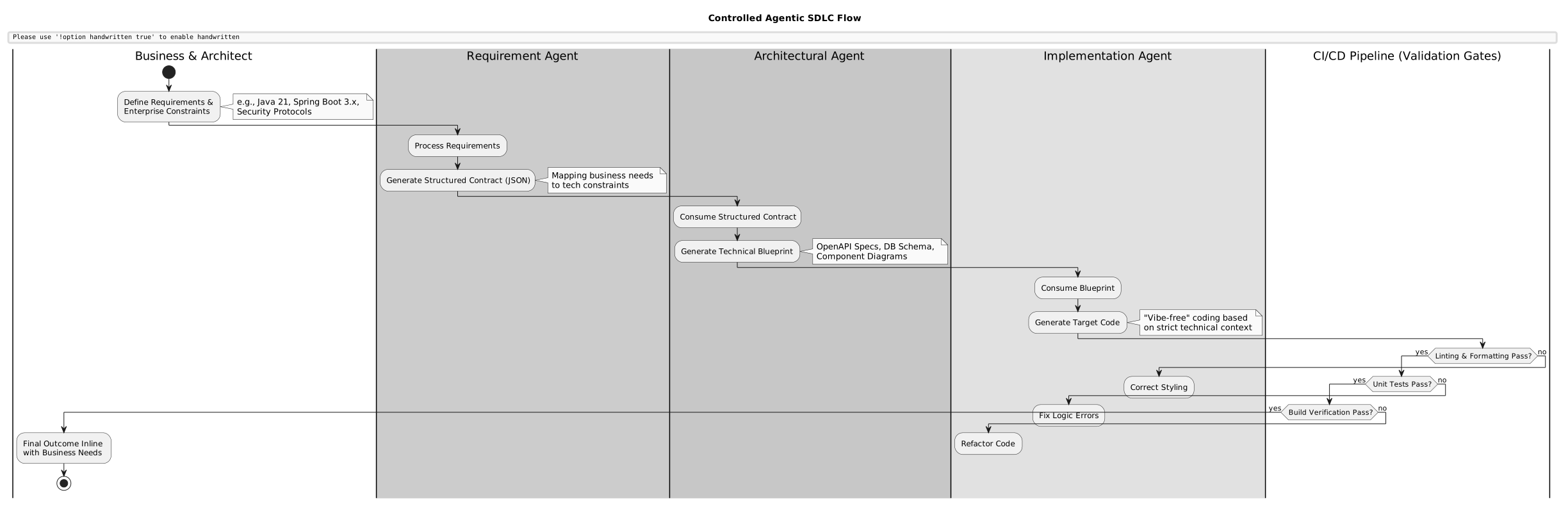
To visualize how we move from a vague “summary of requirements” to a deterministic output, the following PlantUML diagram represents the structured flow of an Agentic SDLC. In this model, every phase is a “gate” where expectations must be met before the next agent begins its task.
Ten years ago, deploying a frontend application was often a manual, highly stressful event. Developers would finish a sprint, compress the project files, FTP them onto a remote server, and cross their fingers hoping no unexpected errors crashed the website. Today, modern development relies heavily on CI/CD—Continuous Integration and Continuous Deployment—to automate, test, and safely deploy code at scale.
As we transition into the era of Agentic Development, we face a similar “manual and stressful” hurdle. Many teams are currently “vibe coding”—feeding a loose summary of requirements into an AI and hoping the output aligns with the enterprise architecture. In classic enterprise transformation projects, this lack of control leads to significant drift. To succeed, we must apply the same rigors of CI/CD to AI Agents: clearly defined phases, strict expectations, and immutable constraints.
The Problem: The “Vibe Coding” Drift
When AI agents are given broad, unstructured tasks, the “hallucination” isn’t just about facts—it’s about architectural drift. In a large-scale Java or Microservices environment, an agent left to its own devices might choose a library that isn’t approved or ignore specific security protocols.
Without a controlled flow, the delta between the business need and the final code grows with every iteration.
The Solution: Phase-Gated Agentic SDLC
Instead of one giant “prompt and pray” session, we break the SDLC into discrete, controlled units where the output of one Agent is the strictly validated input for the next.
1. Requirements & Constraint Mapping
Before a single line of code is written, an agent is tasked with mapping business requirements against enterprise constraints.
- Example: If you are building a Spring Boot application, the agent is provided with your specific tech stack (e.g., Java 21, Spring Boot 3.x, Neo4j).
- The Constraint: The Agent must output a structured
requirements.jsonthat includes security headers and database schema limitations.
2. Architectural Blueprinting
A secondary agent receives the requirements.json and generates the technical contract—OpenAPI specs, class diagrams, or sequence flows.
- The Control: This output must be validated against your existing Microservices architecture. If the agent suggests a synchronous call where an event-driven pattern is required, the “gate” fails.
3. Targeted Implementation (The Coding Phase)
Now, the coding agent receives a highly specific “unit of work” rather than a “vibe.”
- Example: “Implement the
UserRegistrationservice using the providedrepository-contract.javaand ensure it uses theCustomExceptionclass defined in the core module.”
Integrating with CI/CD
Just as CI pipelines use ESLint and Jest to catch syntax and logic errors, an Agentic SDLC uses AI-Assisted Linting.
Every piece of code generated by an agent must pass through the same pipeline mentioned earlier:
- Linting & Formatting: Ensuring the AI-generated code follows the team’s Prettier/ESLint rules.
- Automated Unit Testing: Running Vitest or Jest to ensure the Agent didn’t break existing logic.
- Build Verification: Ensuring the code actually compiles within the framework (React, Vue, or Spring Boot).
The Benefits of Control
By moving away from summary-based coding and toward a phase-gated approach, enterprise teams gain:
- Predictability: The final outcome is inline with business needs because expectations were set at every micro-step.
- Scalability: You can deploy multiple agents to different modules simultaneously without them drifting apart.
- Confidence: Much like how CD gives developers the confidence to ship multiple times a day, a controlled Agentic flow gives architects the confidence that AI-generated code won’t become technical debt.
In the world of senior architecture, “control” isn’t a bottleneck—it is the enabler of speed.