Introduction
As Artificial Intelligence evolves from simple conversational bots to complex, autonomous agentic workflows, the underlying data structures must adapt. Traditional relational databases and flat NoSQL structures often struggle to maintain the rich, interconnected context that AI agents require to reason effectively. This is where Graph Databases become significant in the AI era.
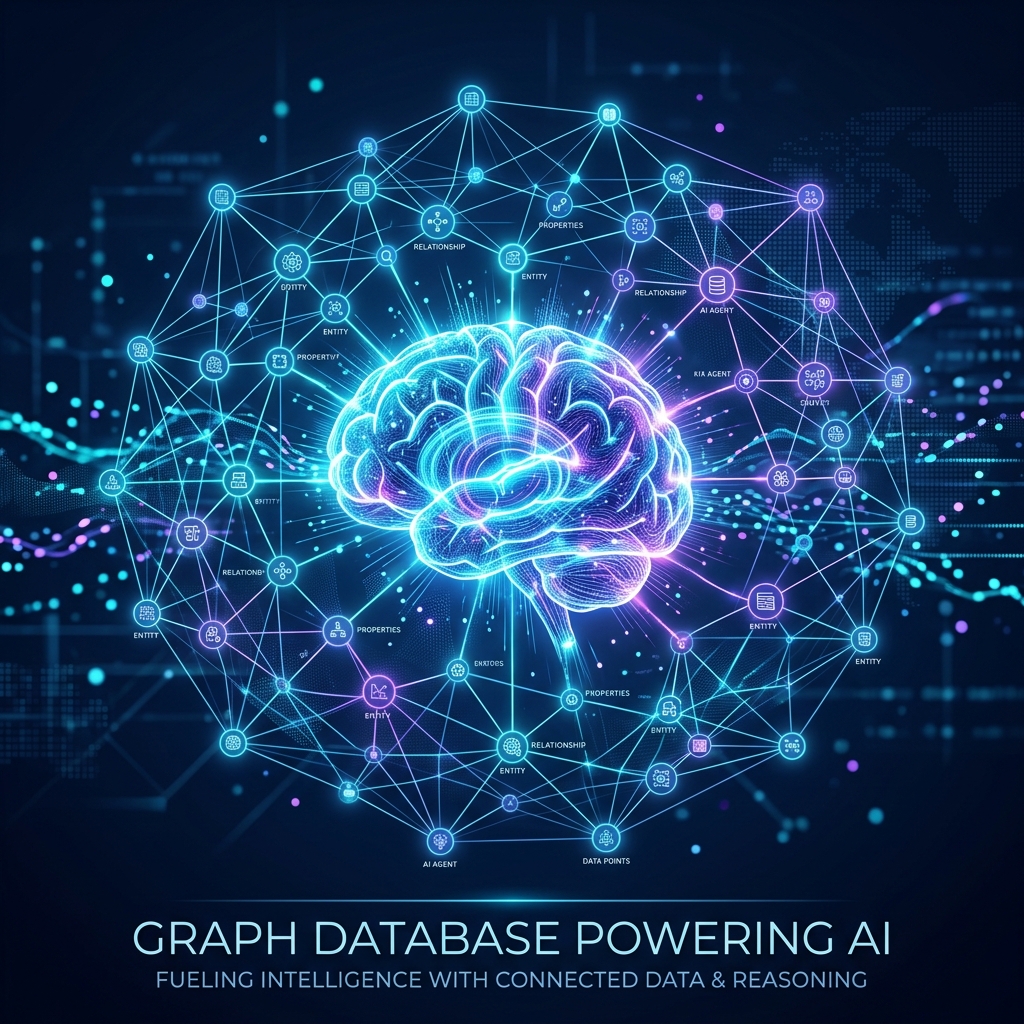
By representing data as nodes (entities) and edges (relationships), graph databases provide a natural intuition for how information connects, allowing AI agents to traverse knowledge spaces, infer hidden connections, and make decisions with multi-hop reasoning.
Usages of Graph Databases in AI-Driven Agentic Workflows
Graph databases provide pivotal capabilities for AI agents across several domains:
- Retrieval-Augmented Generation (Graph RAG): Traditional RAG relies on vector similarity, which can miss contextual relationships. Graph RAG combines knowledge graphs with LLMs, giving agents deterministic paths to trace facts, resulting in more accurate and context-aware responses with significantly reduced hallucinations.
- Context Memory for Agents: Agents operating over long horizons lose context if it’s stored flatly. Graph databases act as long-term memory, mapping user preferences, past interactions, and environmental states as an evolving network of concepts.
- Multi-Agent Collaboration: In a system where multiple agents interact (e.g., a coding agent, a reviewing agent, and a testing agent), a graph database serves as the shared “world model.” It maps out architectures, code dependencies, and component relationships, ensuring all agents have a synchronized source of truth.
- Root Cause Analysis & Diagnostics: AI agents tasked with Site Reliability Engineering (SRE) or debugging can use graphs to traverse dependency trees. If a microservice fails, the agent queries the graph to instantly identify downstream impacts and upstream dependencies.
- Recommendation & Personalization Engines: By analyzing user behavior patterns stored as graph traversals, agents can deliver hyper-personalized recommendations based not just on isolated interactions, but on complex network patterns.
Deep Dive: Graph Databases in Cybersecurity Threat Hunting Workflows
Let’s look at a detailed example of how a graph database is utilized in an AI-driven agentic workflow designed for Cybersecurity Threat Hunting.
The Scenario
An enterprise security operations center (SOC) deploys an autonomous AI agent to constantly monitor network activity and identify potential Advanced Persistent Threats (APTs).
The Architecture
Instead of storing logs in a flat repository, every event is streamed into a graph database (like Neo4j or Memgraph).
- Nodes: IP Addresses, Users, Devices, Processes, Files.
- Edges (Relationships):
LOGGED_INTO,EXECUTED_PROCESS,ACCESSED_FILE,COMMUNICATED_WITH.
How the Agentic Workflow Uses the Graph
1. Contextual Anomaly Detection A traditional SIEM rule might flag a user logging in at an unusual time. However, the AI Threat Hunting Agent uses the graph to look deeper. The agent queries the graph to see: “Did User X log into Server Y (which they’ve never accessed), and did that server immediately COMMUNICATE_WITH an external IP Address Z?”
2. Multi-Hop Reasoning When the agent detects an anomalous file execution, it doesn’t just block the file. It performs a multi-hop traversal query:
- Find the
File. - Traverse to the
Processthat created it. - Traverse to the
Userwho spawned the process. - Traverse to the
IP Addressthat the user initially connected from. - Identify all other
Userswho connected from that sameIP Addressin the last 48 hours.
The agent uses this graph traversal to construct a complete “blast radius” narrative.
3. Actionable Output Instead of sending a human analyst an isolated alert, the AI agent uses the graph data to generate an automated incident response summary. It formulates a mitigation plan: “Disable User X, quarantine Server Y, and block IP Z at the firewall,” and passes this to a higher-level clearance agent for execution.
Conclusion
In the AI era, context is king. While vector databases are excellent for semantic search, graph databases are essential for relational reasoning. By integrating graph databases into agentic SDLCs and workflows, we empower AI systems to move past simple text generation to complex logic and reasoning.